
Euro to Dirham Exchange Rate Forecast 2026: Trends & Analysis
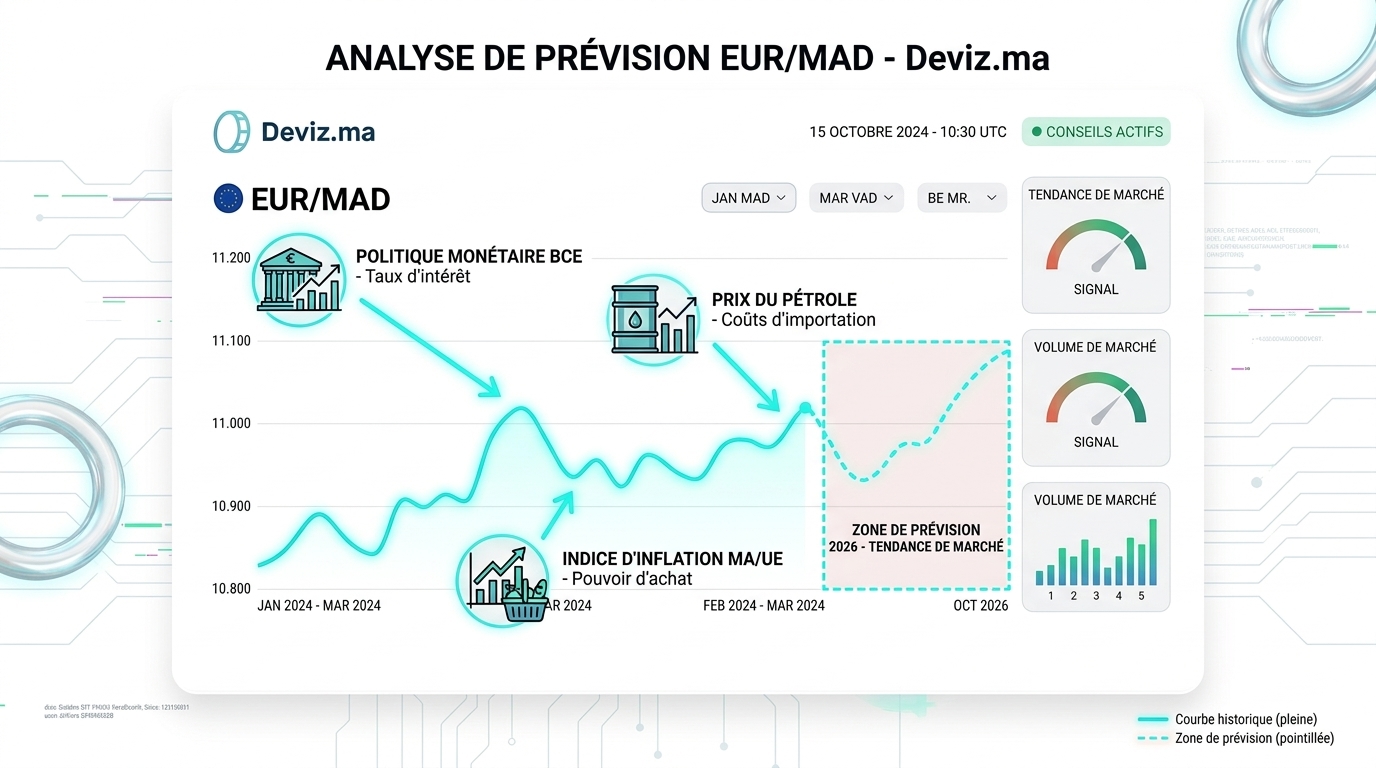
"Will the rate go up or down tomorrow?" — It's the million-dirham question. While no one can predict the market perfectly, here are the key factors influencing the EUR/MAD rate and the trends to watch in 2026.
⚠️ Disclaimer
This article is an informative analysis, not financial advice. Currency markets are inherently unpredictable.
🏛️ How the EUR/MAD Rate Works
The Moroccan dirham is not entirely a "free-floating" currency. Morocco uses a managed float regime:
- Bank Al-Maghrib calculates a central rate based on a basket of 60% Euros and 40% US Dollars.
- The dirham can fluctuate within a ±5% band around this central rate.
This means the EUR/MAD rate is relatively stable compared to other currency pairs, but it can evolve significantly over several weeks.
📊 5 Factors that Influence the Rate
1. ECB Monetary Policy
When the European Central Bank lowers its rates, the euro tends to weaken against the dirham. In 2026, the ECB is maintaining a progressive rate-cutting policy, which could slightly favour the dirham.
2. Oil Prices
Morocco imports almost all its energy. High oil prices increase the dollar bill, putting pressure on the dirham.
3. MRE Remittances
Moroccans Residing Abroad send over 100 billion MAD annually. These inflows support the dirham, especially during Summer and Ramadan.
4. Tourism
A strong tourism season increases the supply of euros and dollars, bolstering the dirham.
🔮 Scenarios for 2026
| Scenario | EUR/MAD Range | Probability |
|---|---|---|
| Status quo | 10.50 — 11.00 | High |
| Stronger Euro (ECB hikes) | 11.00 — 11.30 | Medium |
| Weaker Euro (ECB cuts) | 10.20 — 10.60 | Medium |
| Oil Shock / Crisis | 9.80 — 10.30 | Low |
📱 The Best Strategy
Instead of timing the market, follow the real-time rate on Deviz.ma. If you are travelling soon and the rate exceeds 10.80, go ahead and exchange. Waiting for the "perfect rate" rarely pays off for retail amounts.
This article is part of
Euro to dirham: the complete guide →By Hed Diou
Hed Diou is behind Deviz.ma, the platform where licensed exchange offices in Morocco compete for each request. He follows partner offices’ rates and customer requests every day.